Data breach costs: what an exposed key finding can tell you
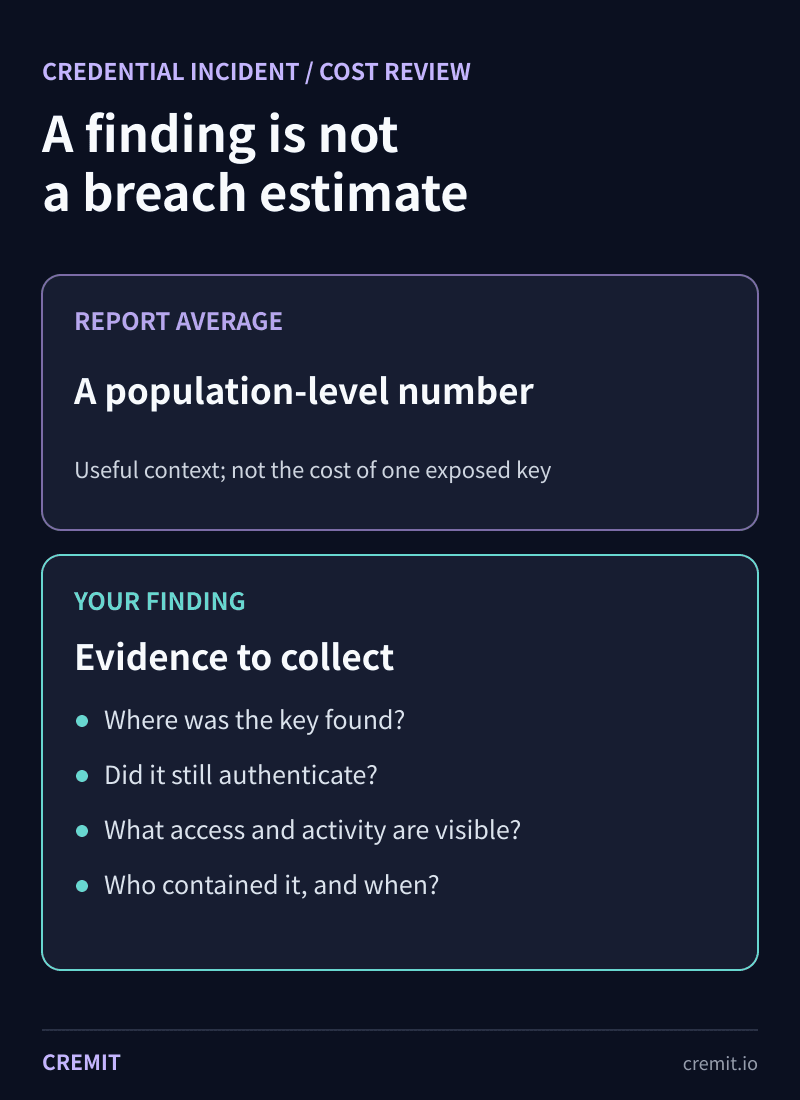
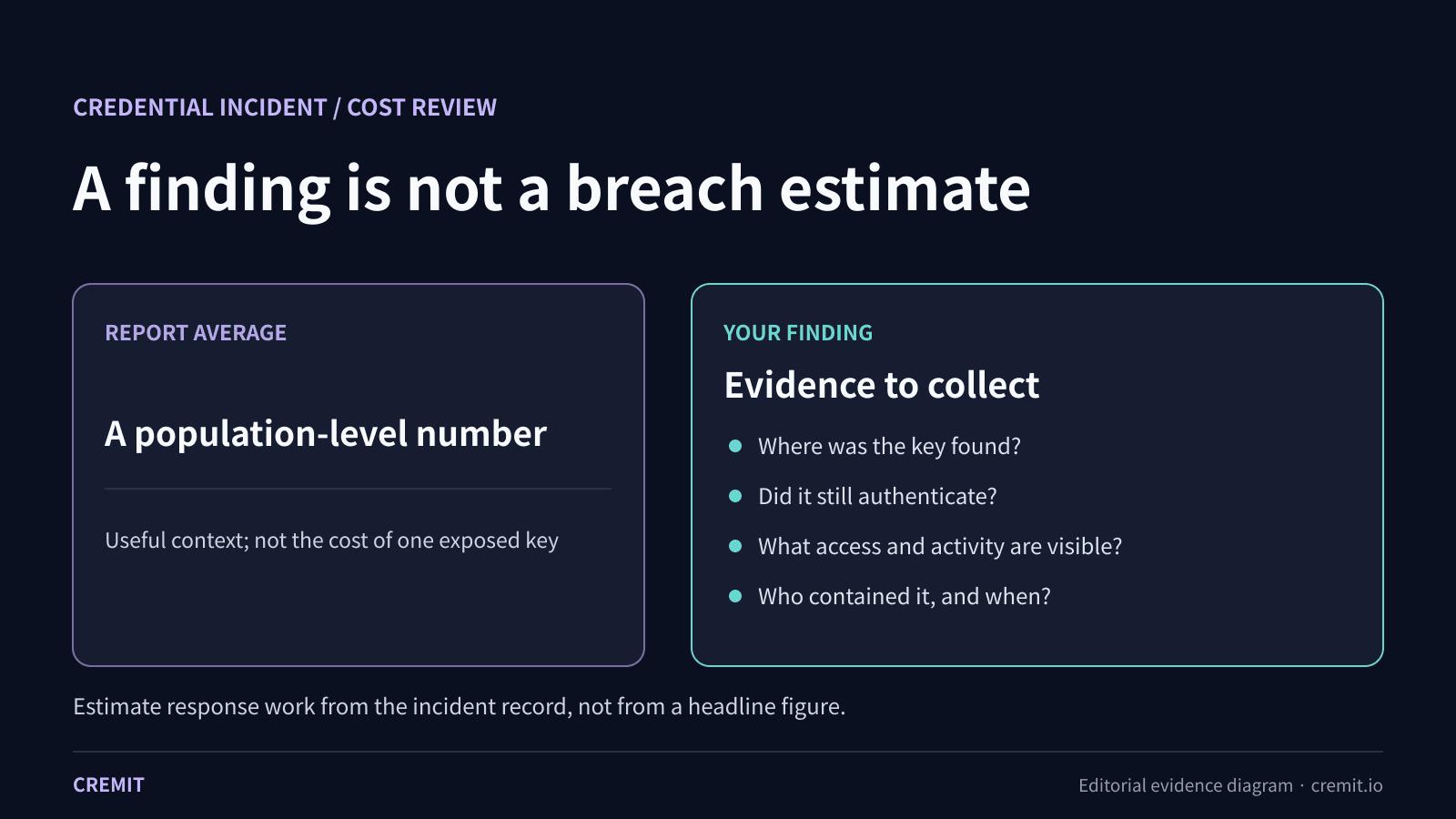
A breach-cost average cannot price one exposed credential. Record the key’s source, issuer status, available access and activity evidence, and response work before estimating impact.

On this page(5)
Can a leaked-key alert tell you how much a data breach will cost? No. A pattern match identifies a possible credential and where it appeared. It does not establish unauthorized use, data loss or a bill. The useful next step is to check the key and keep an incident record.
What the breach-cost average measures
IBM’s 2026 Cost of a Data Breach research reports a USD 4.99 million global average across 602 organizations that had a data breach. It groups costs into detection and escalation, post-breach response, notification and lost business. That is a descriptive average for studied breaches, not the expected loss from any one exposed key or the amount a scanner will save. The earlier version of this article mixed a 2024 average with a 2025 cybercrime forecast and treated them as if they predicted the value of secret detection. They do not.
What a credential finding does and does not establish
Start with the source: which connected repository, object, document or message contained the value, and who could access it? A secret pattern is a candidate, not proof that the string authenticates. For supported types, check the current result at the issuer. AWS or GCP access analysis can add available permission context. Neither validity nor permission context proves that someone used the key. Review relevant issuer activity logs and their coverage before deciding whether an incident involves actual access.
For an AWS access key, CloudTrail can look up recent management events by access key ID, within its documented time and Region limits. Other event types and older periods need the logs you configured and retained. An empty lookup is not proof that no request occurred anywhere. Preserve the event window and your query parameters in the incident record.
Record the work and impact you can verify
Keep five records: the discovery source and time; the issuer-side key state; the affected identity and available access; the activity and data reviewed; and who replaced or revoked the key, when, and which workloads needed an update. Record response hours, service interruption and external assistance only if they actually occurred. Determine any notification or legal obligation from the facts of the incident and applicable rules, not from a generic breach average. Never paste the secret value into the ticket.
If the key reached Git, remove it from the change and consider history cleanup after containment. GitHub recommends revoking or rotating a leaked credential first; deleting a file or rewriting history cannot recall copies held elsewhere. For AWS IAM access keys, follow the issuer’s replacement procedure and test dependent applications. Google Cloud has a separate procedure for compromised service-account keys, including the effect of disabling a service account on workloads.
Where detection helps
A pre-commit or provider push check may keep a supported pattern out of a shared repository when it runs and is not bypassed. A connected-source scan can find a value already present in its configured scope. Cremit can bring supported issuer validity, available AWS/GCP access context, source location and owner clues together for review. It does not prevent every leak, restrict cloud access, calculate breach cost or revoke keys automatically. A response owner still has to investigate and act at the issuer.
Use the evidence to decide which response work is necessary. NIST’s current incident-response guidance treats detection, response and recovery as connected organizational work; it does not turn one indicator into an incident severity or a financial estimate.
Primary sources
IBM 2026 Cost of a Data Breach research and sample
IBM explanation of breach-cost categories
AWS CloudTrail access-key event lookup
GitHub sensitive-data removal and rotation
Read next
AITU CTF Final 2026 Writeup
Full writeup of the AITU CTF Final (April 25-26, 2026), a HackCity-format competition. We walk through exploiting DMZ hosts via XXE, SSTI, and SQLi, pivoting into the DEV segment through AD lateral movement, escaping a privileged Docker container via cgroup abuse, and breaching a healthcare system through JWT JKU header injection.
Secret scanning false positives: how to triage findings
A pattern match, a revoked key, and an unverified key need different responses. Learn how to separate them and prioritize exposed credentials.
The machine access behind an exposed API key
An exposed key is a lead. Connect it to its issuer, principal, permissions, workload, and owner before closing the access path.
Get the next one in your inbox
Monthly NHI security brief from Cremit. One email, high signal.