The machine access behind an exposed API key
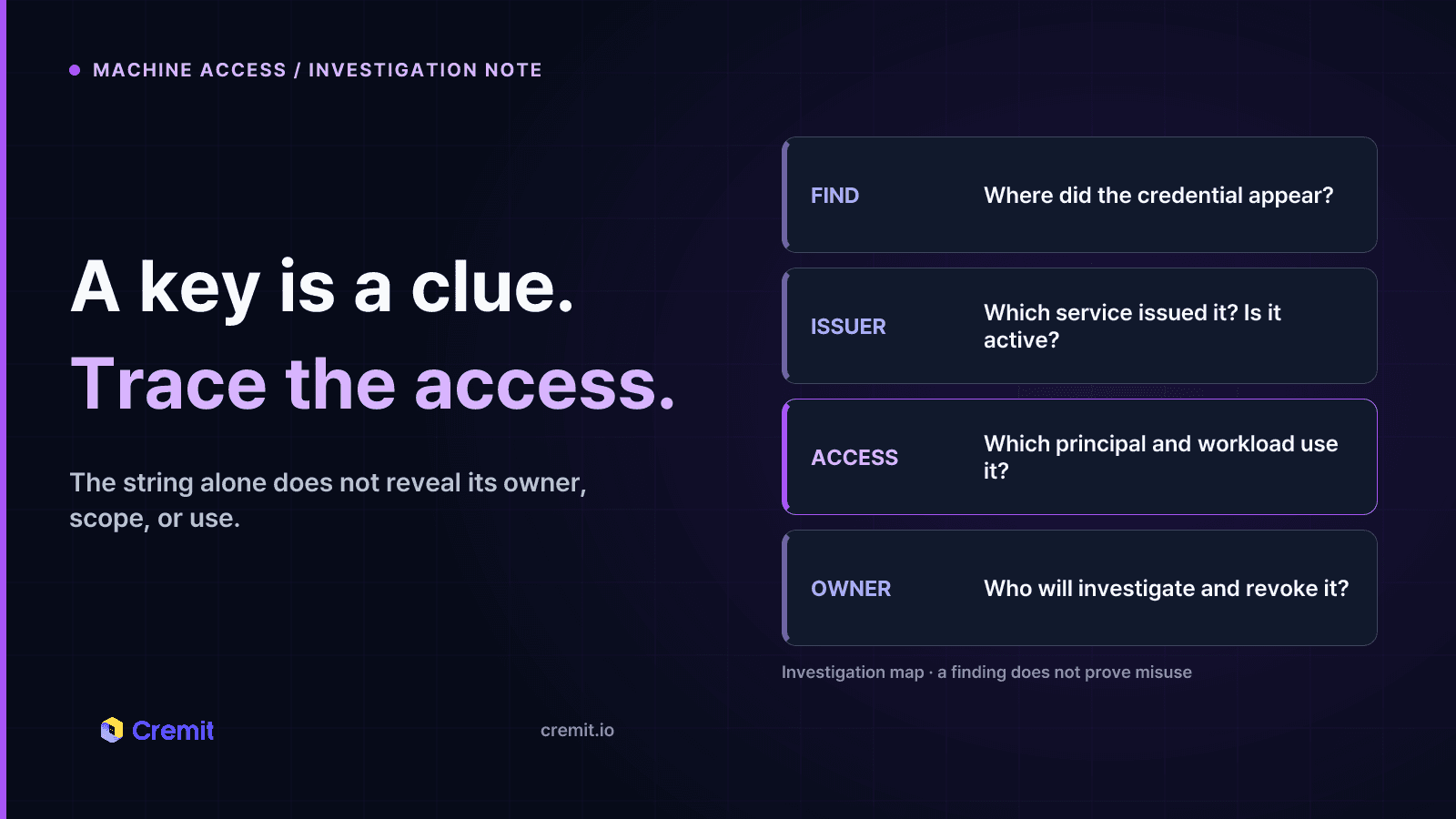
An exposed key is a lead. Connect it to its issuer, principal, permissions, workload, and owner before closing the access path.

On this page(5)
Revised October 4, 2026. The earlier article used unlinked claims about specific organizations, assumed that every exposed token was abused within minutes, and asked whether a product could find every leak in real time and rotate keys automatically. Those statements exceeded the evidence and Cremit Platform’s current scope. The useful question is narrower: when a credential is found, what access does it represent, and who can close it?
A credential points to access; it is not the whole identity
An API key, service token, or cloud access key can authenticate a workload or account. The string itself does not tell you who owns the service, what permissions the account has, or whether someone else used it. Some workloads use short-lived credentials obtained through a role or federation rather than a stored static key. AWS recommends temporary credentials where possible instead of long-term access keys. Treat “non-human identity” as the account or workload and its access path, not as a synonym for every secret string.
Finding a key in a public repository or shared document establishes exposure at that location. It does not establish validity, misuse, or a breach. A scanner can miss a key type or a source it cannot inspect. GitHub publishes its supported secret patterns and validity-check coverage; review those boundaries before interpreting an empty result.
Connect the finding to a service and owner
Record where the credential was found and the first time you can verify that location. Identify the issuing service, credential type, associated account or principal, permissions, expiry, and workload that uses it. Name a responder who can coordinate with the service owner. The person who committed the file may be a useful lead, but ownership requires confirmation.
Check validity through the issuer when a safe supported method exists. For other types, ask the owner to review the issuing service. Map dependencies before a rotation so production work does not lose access without a replacement. If the key is potentially active and exposed, limit the time it remains usable. OWASP’s secrets-management guidance treats creation, rotation, revocation, and expiration as distinct parts of a secret’s lifecycle.
Close the access path and verify the result
Revoke or rotate the credential at its issuing service, then confirm the old value fails and the replacement workload still runs. Review issuer logs for unexpected use within their actual coverage and retention. An empty log search does not prove the credential was never used. Remove exposed copies and fix the path that produced the leak. GitHub advises revoking or rotating a secret before attempting to remove it from repository history.
Track useful operational evidence: which sources are connected, which findings are confirmed active, who owns each response, when issuer-side revocation was verified, and what remains unknown. A time interval is meaningful only when its start and end events are defined. Avoid a universal “minutes to abuse” claim or a promise of zero leaks.
Where Cremit fits
Cremit Platform detects credentials in supported connected sources and approved external exposure surfaces. It verifies supported types with issuing services and lets a team assign and track a finding. It does not infer every credential owner, cover every source in real time, establish attacker use, or automatically revoke and rotate keys. The issuer and the application owner remain responsible for access policy, logs, and the final change.
Primary sources
OWASP — Secrets Management Cheat Sheet
AWS IAM — Manage access keys for IAM users
Read next
Public API key in a repository: what to check first
A public commit proves exposure, not misuse. Check validity, permissions, issuer logs, and dependent workloads before closing the incident.
MCP Servers Are Taking API Keys Through the Chat Window
We sent one initialize request to every remote MCP server in the official registry. 71.3% of 22,027 responding servers opened a session with no header authentication, and 3,705 credential fields sit in tool arguments. Three of them are marked secret.
How to count live credentials without confusing matches and keys
Count observed locations, distinct credential records and verification states separately. Define scope and check time before reporting exposure.
Get the next one in your inbox
Monthly NHI security brief from Cremit. One email, high signal.